Student work and the 5 C's
In our fifth- and sixth-grade Spanish classroom at the Academy of the Sacred Heart, language acquisition comes alive through the national standards for world language learning: Communication, Cultures, Connections, Comparisons, and Communities. Through comprehensible input, storytelling, interdisciplinary inquiry, and joyful cultural traditions, students do not simply memorize words. They use Spanish with real purpose and creative confidence.
Communication
Student Story Writing
ACTFL Standard: Presentational Communication
Through storytelling and comprehensible input, students develop the language skills needed to communicate their own ideas in Spanish. After listening to and interacting with stories in class, students use familiar vocabulary and language structures to create original written narratives. This activity encourages creativity, builds confidence, and allows students to demonstrate their ability to communicate meaning in the target language.


Cultures
Ofrenda del Día de Muertos
ACTFL Standard: Relating Cultural Practices and Products to Perspectives
Students explore Día de los Muertos by learning about its traditions, symbols, and cultural significance. Through the creation and study of an ofrenda, they develop an understanding of how photographs, marigolds, candles, and personal belongings represent remembrance, family connections, and cultural beliefs. Students move beyond identifying cultural objects to understanding the meaning and values behind the tradition.


Connections
Interdisciplinary Alebrije Project
ACTFL Standard: Making Connections Across Disciplines
This interdisciplinary project connects Spanish, Art, and English Language Arts through the study of Mexican alebrijes. Students create their own alebrijes in Art class, write descriptive paragraphs about their creations in Spanish, and compose original literary pieces inspired by their artwork in English. By connecting language learning with visual arts and creative writing, students apply their knowledge across multiple subjects while developing artistic expression, vocabulary, and writing skills.


Comparisons
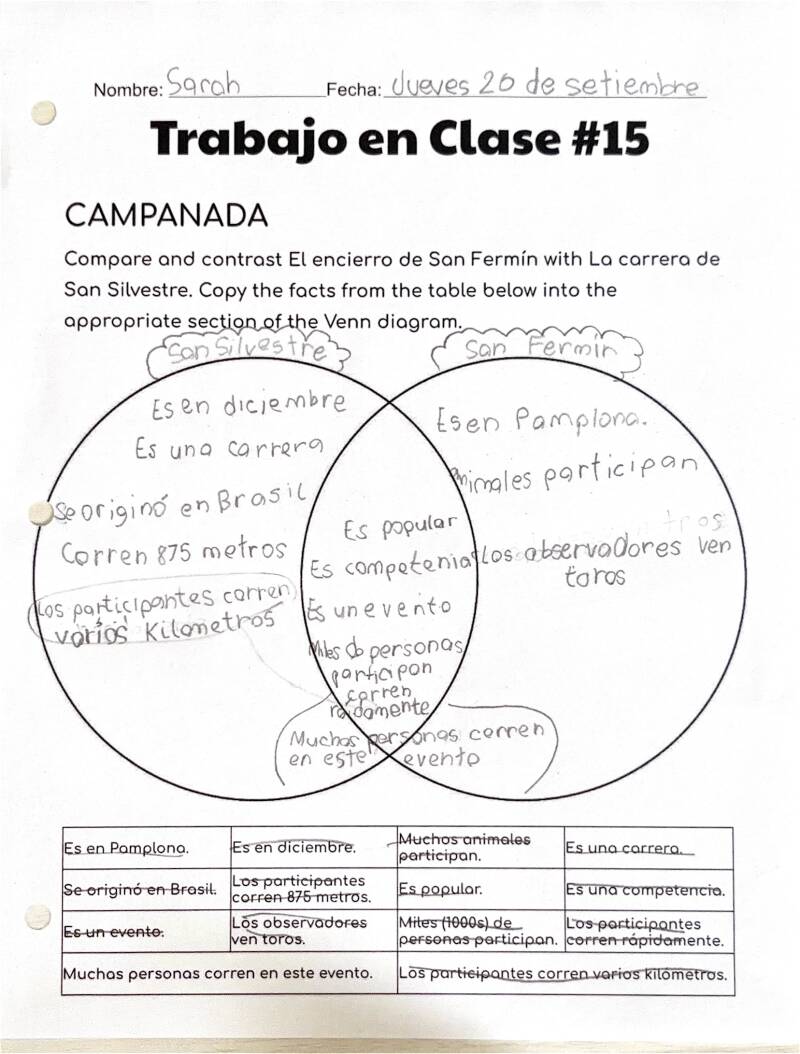
San Fermín and La Carrera de San Silvestre
ACTFL Standard: Cultural Comparisons
Students investigate two traditions celebrated in Spanish-speaking communities: San Fermín and La Carrera de San Silvestre. Through research and written comparisons, they identify similarities and differences in the events' purposes, traditions, and cultural significance. This activity develops students' ability to observe cultural practices, recognize diversity within the Spanish-speaking world, and understand how traditions reflect the identities and values of different communities.
Communities
Sacred Heart Chapel and Remembrance
ACTFL Standard: School and Global Communities
Students extend their language learning beyond the Spanish classroom by participating in a schoolwide Día de los Muertos chapel honoring a former classmate and a teacher who have both left us far too early. As part of this meaningful community experience, students write personal messages of remembrance in Spanish and place them in the school ofrenda. The school community also comes together to pray the Ave María in Spanish.
This activity allows students to experience Spanish as a language of faith, compassion, and connection. Through their writing and participation, they see how language can serve a meaningful purpose within their school community while developing cultural understanding and empathy.


Reflection on Student Work and Instructional Practices
After more than twenty years in education, I continue to believe that students learn a language best when they have opportunities to experience it, understand it, and use it for meaningful purposes. In my fifth- and sixth-grade Spanish classroom at the Academy of the Sacred Heart, I strive to create an environment where students feel comfortable taking risks, expressing ideas, and discovering the joy of learning another language. The student work samples included in my portfolio reflect this philosophy and demonstrate how I incorporate effective language teaching practices, the World-Readiness Standards, differentiated instruction, cultural understanding, and ongoing feedback into my teaching.

Encouraging Target Language Proficiency
I believe students need consistent exposure to meaningful Spanish to develop proficiency. I use the target language throughout instruction, making it comprehensible through gestures, facial expressions, repetition, visuals, and familiar language structures.
Storytelling is especially important in my classroom because it allows students to encounter language repeatedly in engaging contexts. Students listen, respond to questions, participate in developing stories, and gradually move toward creating their own written narratives. The writing samples in my portfolio illustrate this progression from comprehension to independent expression.
My goal is not immediate grammatical perfection but the development of confident communicators who understand that Spanish is a language they can use to express themselves. I encourage students to take risks, build on what they already know, and recognize their progress.

Differentiation and Meeting Individual Needs
Every student enters my classroom with different experiences, strengths, and levels of confidence. My Montessori background has shaped my understanding of the importance of meeting students where they are and providing different pathways toward a common learning goal.
I differentiate instruction through visual supports, movement, guided practice, repetition, and opportunities for both collaborative and independent learning. Some students benefit from sentence starters and familiar vocabulary, while others are ready to expand their ideas with additional details and more complex language.
Activities such as illustrated storytelling and creative writing allow students to demonstrate understanding in ways that build on their individual strengths. I strive to maintain meaningful expectations while providing the support each learner needs to experience success and continue progressing.

Integrating Culture into Language Learning
Culture is not an occasional addition to my curriculum; it is an essential part of understanding language and the people who speak it. I want students to explore not only what people do in different cultures, but also why those traditions matter.
Our Día de los Muertos project is a meaningful example. Students learn about the significance of the ofrenda, the symbolism of its elements, and the importance of remembrance in Mexican culture. The experience becomes especially personal as our school community honors the memory of a student and a beloved teacher.
Through the alebrije project, students explore Mexican artistic traditions while connecting Spanish to creative work in other subjects. By comparing cultural celebrations such as San Fermín and San Silvestre, they practice observing similarities and differences while developing curiosity and respect for other perspectives.
These experiences help students recognize that learning another language also means learning to see the world through different cultural lenses.

Feedback and Assessment for Growth
I view assessment as an opportunity to understand student progress and guide future learning. Daily retrieval activities, classroom interactions, comprehension questions, writing assignments, and exit tickets help me identify what students understand and where additional support is needed.
I provide feedback that emphasizes both what students are doing successfully and the specific steps they can take to improve. In written work, I focus on comprehensibility, appropriate use of familiar language structures, and the ability to communicate meaning. Rubrics and clear expectations help students understand learning goals, recognize their strengths, and identify areas for growth.
I also value opportunities for students to revisit and improve their work. My intention is for feedback to encourage reflection and progress rather than simply assign a grade.
The student work represented in this portfolio reflects what I value most as a language educator: meaningful communication, creativity, cultural understanding, and student growth. I want my students to leave my classroom with more than Spanish vocabulary. I want them to have the confidence to communicate, the curiosity to understand different cultures, and the awareness that language can build connections between people.
For me, successful language teaching is not measured only by what students can remember, but by what they can understand, express, and carry with them beyond the classroom.